Building Cross-Domain AI Smart Application Ecosystem Starting from Industry Pain Points
Establishing a Cross-Domain AI Innovation Methodology and Smart Application Ecosystem Based on Industry Pain Points
August 12, 2026 96
The article explains that the current thinking for artificial intelligence development should originate from "solving real-world problems" rather than mere technological stacking. Its core concept establishes a five-layer architecture: first, defining specific industry pain points (such as B&B occupancy rate prediction or financial trend judgment); next, transforming these scenarios into datasets understandable by AI; then, building models using technologies like machine learning. Furthermore, the research outcomes must be engineered into operable smart systems to finally form a cross-domain application ecosystem. This "problem-oriented" methodology emphasizes establishing a continuously iterative AI innovation cycle: starting from identifying industry pain points, proceeding through data accumulation, model training, and system construction, ultimately transforming insights into actual operational value, which is then fed back to the data layer for optimization learning.
The journey of AI startups: AI SYSTEM Problem → Data → Algorithm → System → Application. "AI is not just technology; it is the ability to transform real-world problems into intelligent decision-making."
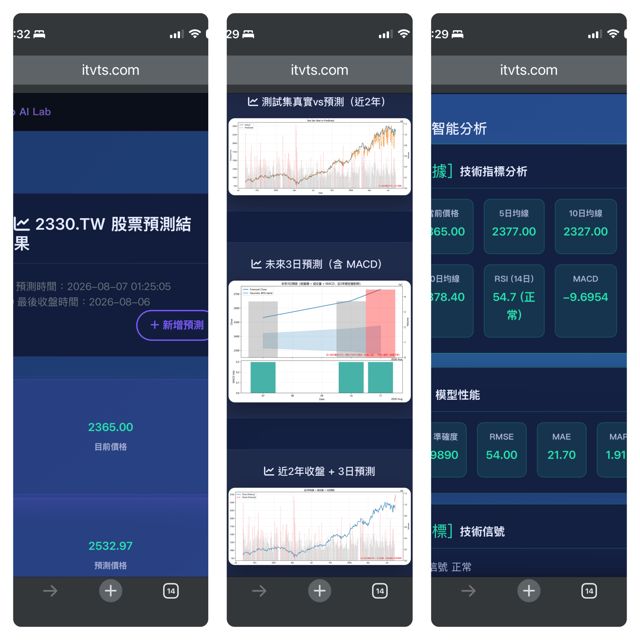
The overall concept can be broken down into five levels: First level | Problem. Start from real-world problems rather than deciding which type of AI to use first. For example, B&Bs face issues with booking occupancy rates and demand forecasting; financial markets face issues with price and trend judgment; digital assets face inheritance issues; drones face failure and remaining lifespan issues; and the news industry faces content production and cross-lingual dissemination issues.
Second Layer | Data. Converting problems from different industries into data that AI can understand, including historical bookings, room rates, traveler behavior, stock K-lines and technical indicators, digital asset status, drone sensor signals, as well as news text, images, and member behavior.
Third Layer | Algorithms: Reutilizes technologies such as machine learning, deep learning, optimization algorithms, time series, survival analysis, natural language processing, and large language models to establish prediction, classification, judgment, and generation capabilities.
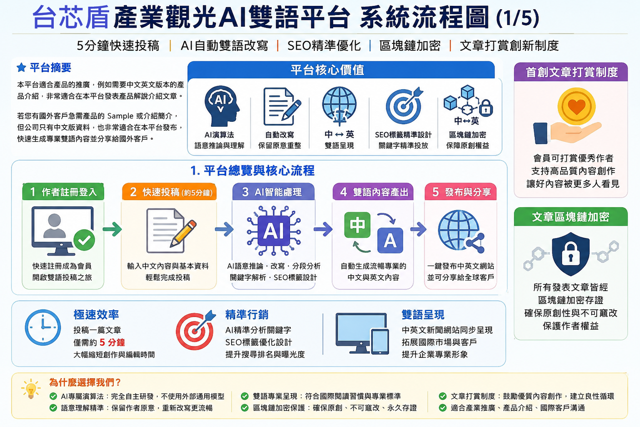
Fourth Level | Intelligent System: Research outcomes cannot remain in the form of papers or models; they must be further engineered into truly operable systems, such as an AI hostel prediction platform, a financial prediction platform, an AI survival wallet, a UAV health doctor, and the ITVTS AI bilingual news platform.
Fifth Floor | Cross-domain Intelligence. Finally, it can be found that although the five domains appear completely different, they actually share a common structure: Real Problem → Data → AI Algorithm → Prediction/Judgment → Intelligent Decision Making → Platformization → Industry Application
We are not researching AI for the sake of AI; rather, we start from industry problems, build models using data, form intelligence through algorithms, and then transform that intelligence into a truly usable platform.
How a single set of AI innovation methodologies can cross five different industries to gradually form an AI smart application ecosystem.
AI Minshu Prediction | AI Financial Prediction | AI Survival Wallet | UAV Health Doctor | ITVTS AI Bilingual News Platform Research Starting Point | Core Concepts The starting point for AI research should not just be "what new AI technologies exist now," but rather returning to what real-world problems have not yet been effectively solved.
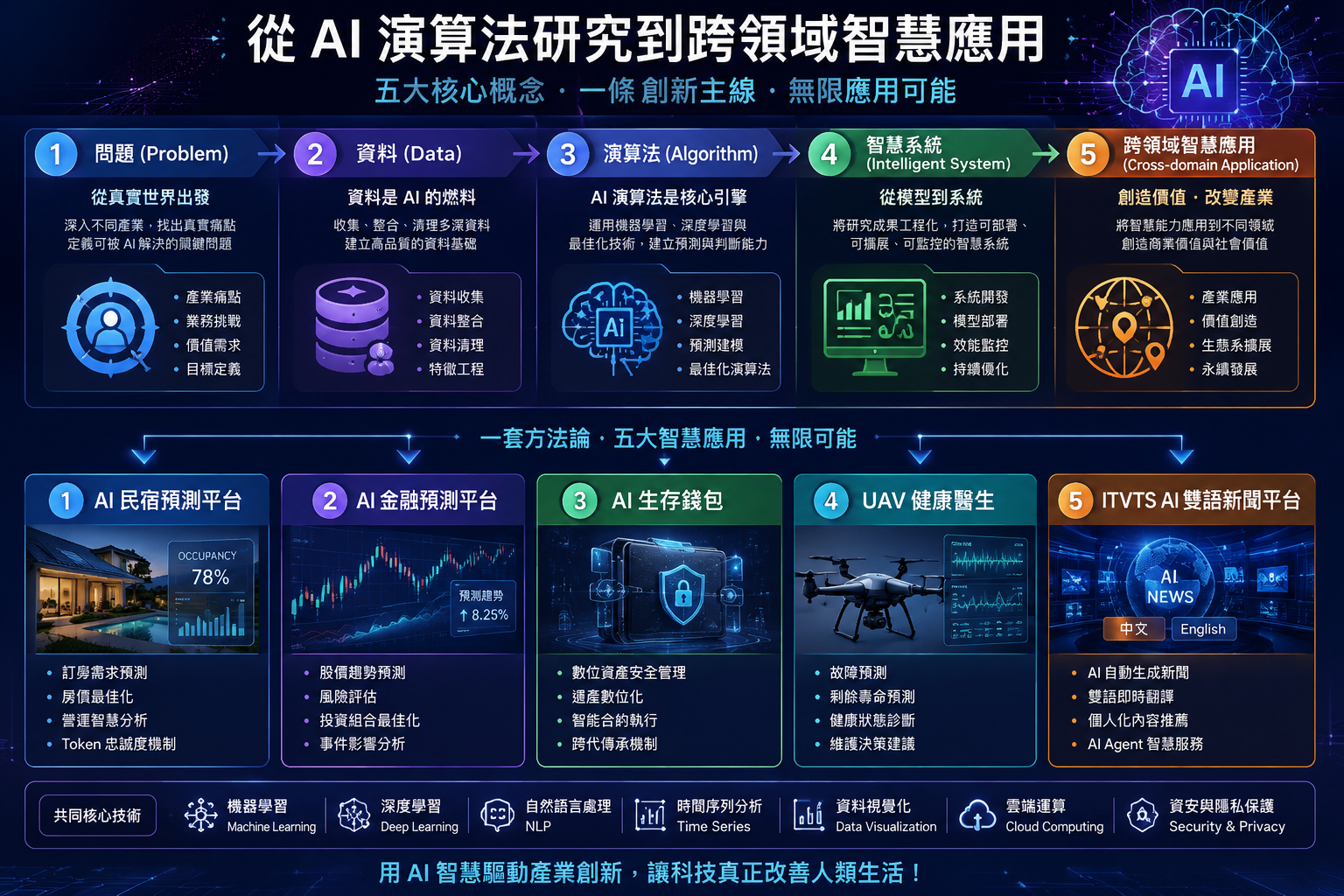
Therefore, the entire research and creation process adopted a "Problem-Driven AI" methodology: Identify industry problems → Collect data → Build AI models → Verify predictive capabilities → Construct systems → Introduce into industry → Continuous learning and improvement. This is also the common methodology for the subsequent five AI applications.
Five research motivations: 1. Accommodation and lodging industry booking uncertainty: There is high uncertainty in bookings for accommodations and lodgings. The goal is to utilize historical booking data, dates, room types, prices, and other features to build AI predictive capabilities, helping operators move from
Therefore, further development of the ITVTS AI bilingual news platform is underway, integrating AI into content processing, translation, SEO, categorization, and bilingual dissemination.
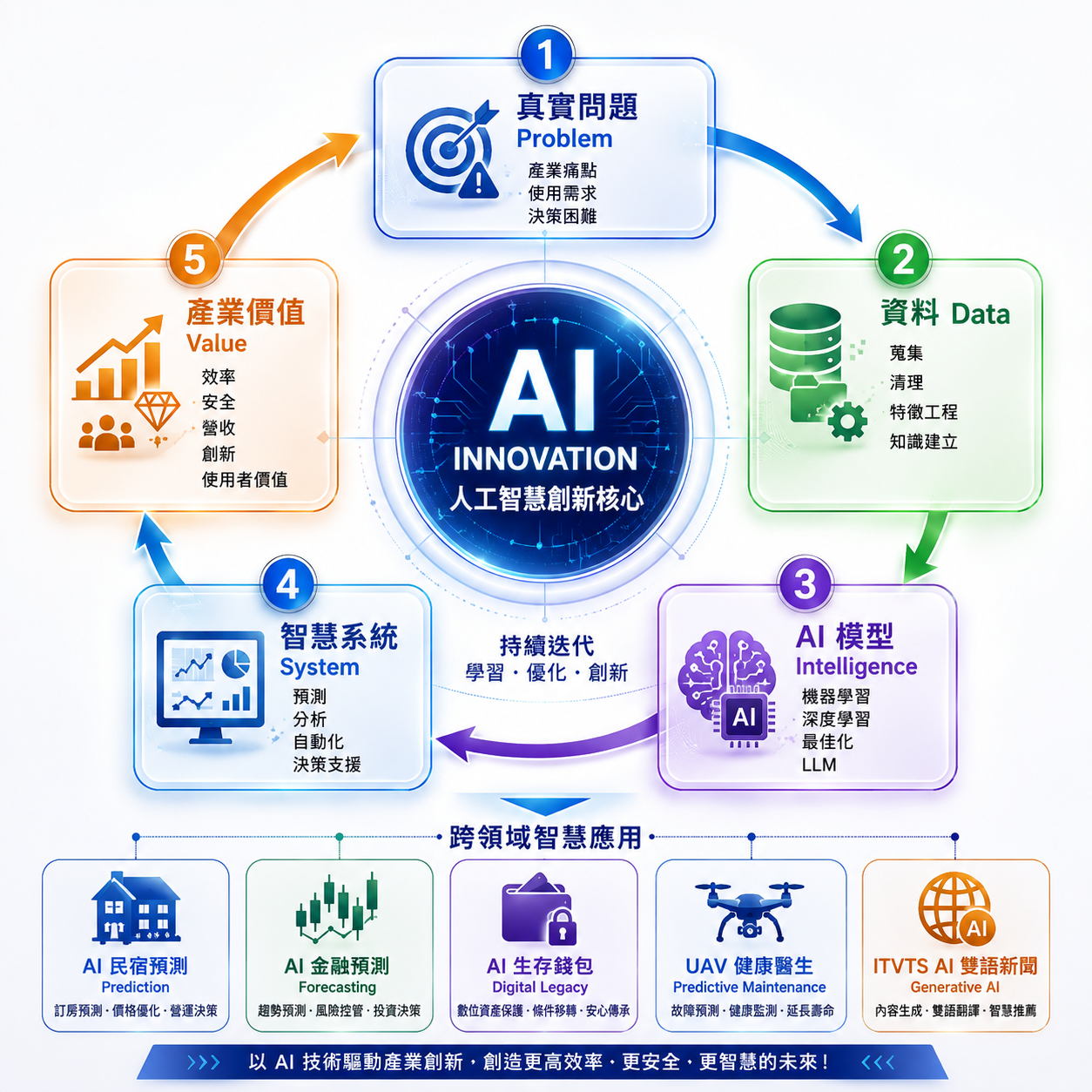
AI Innovation Flywheel ① Real Problems Problem Industry Pain Points / Usage Needs / Decision Difficulties
② Data Collection/Cleaning/Feature Engineering/Knowledge Building
③ AI Models: Intelligence, Machine Learning/Deep Learning/Optimization/LLM
④Intelligent Systems (智慧系統): Prediction/Analysis/Automation/Decision Support
⑤Industry Value (產業價值): Efficiency / Safety / Revenue / Innovation / User Value. Returning to ①Real Problems (真實問題) forms a continuous AI Innovation Loop.
These five products are not five unrelated studies, but rather the practical application of the same set of AI innovation methodologies to problems in five different industries.
AI development is not the development of a single product, but rather a process of gradual maturation through "research $ ightarrow$ data $ ightarrow$ algorithms $ ightarrow$ systems $ ightarrow$ cross-domain applications $ ightarrow$ ecosystem."

This platform's AI development timeline | 2019–2026 Project Evolution: The creative journey of AI starts from research and data accumulation, gradually progressing to algorithm development, model building, system implementation, and cross-industry application. From early AI hotel booking predictions, it progressively extended to AI financial forecasting, AI survival wallets, UAV health doctors, and finally developed into the ITVTS AI bilingual news platform. This entire process represents AI technology evolving from a "single prediction model" to an "actually operational smart platform," and further integrating into a cross-industry AI intelligent application ecosystem. From research to application, from model to platform, from single system to AI ecosystem.
B&B AI Background | Challenges in the Accommodation Industry. One of the biggest operational challenges for the B&B and accommodation industry is the high degree of uncertainty in future demand. Housing demand is influenced by multiple factors, including peak/off-peak seasons, weekdays/weekends, room rates, events, weather, traveler behavior, and market conditions. If operators rely solely on past experience, it is difficult to accurately predict future booking patterns. Therefore, we aim to introduce an AI prediction model using historical booking and operational data to forecast future booking probabilities, housing demand, and room type demand. Furthermore, by integrating pricing strategies and member loyalty mechanisms, we help B&Bs transition from "experience-based management" to "data-driven intelligent operations."
Five Pain Points • Unpredictable Demand: Today's empty rooms do not guarantee demand tomorrow. • Significant Difference Between Low and Peak Seasons: Accommodation demand is clearly influenced by holidays, seasons, and events. • Difficulty in Optimizing Room Rates: Prices that are too high may lower occupancy rates, while prices that are too low affect revenue. • Varying Room Type Needs: Different travelers have different needs for double rooms, family rooms, private villas, etc.
•Insufficient Customer Return: Establishing long-term membership relationships and loyalty after a single stay is an important issue. From accommodation pain points to AI smart management, accommodation operation pain points include booking uncertainty | peak/off-peak fluctuation | pricing decisions | room type demand | customer return. ↓ Data Accumulation: Historical bookings | room types | prices | check-in dates | traveler behavior | external factors. ↓ AI Prediction: Booking probability | housing demand | room type demand | demand trends. ↓ Smart Decision: Price adjustment | room configuration | marketing strategy | member recommendation. ↓ Token Loyalty Mechanism: Stay → Reward → Token → Discount → Re-stay. ↓ Smart Homestay Operation: Increase housing efficiency × Improve operational decision quality × Increase customer return
Boutique Stay AI Architecture | Data × AI Model × Smart Decision Making. The core of the Boutique Stay AI system is establishing a complete closed-loop architecture of "Data → AI → Prediction → Decision → Feedback." The system first integrates historical booking data, room types, pricing, occupancy rates, guest behavior from the boutique stay, along with external data such as weather, festivals, holidays, and local events. After data cleaning and feature engineering, this information is fed into an AI prediction model. The AI model further analyzes the relationship between various factors and housing demand to generate predictive results such as booking probability, accommodation demand, room type demand, and future trends, which are then converted into practical decisions regarding pricing, room allocation, marketing, and membership management.
Finally, the actual booking results are returned to the database, allowing the model to continue learning and forming a continuously improving AI smart operation cycle.
The most important part of the chart is this final feedback loop: Actual Results → Return to Data Layer → Model Retraining → New Prediction → New Decision. Therefore, what this entire diagram truly conveys is not a unidirectional process, but rather: Data → AI → Prediction → Decision → Feedback → Data, which is an AI Learning Loop (AI Continuous Learning Loop).
Hybrid Algorithms | DE × GA × XGBoost × NARX I. Core Concepts The demand for accommodation bookings is not a simple linear problem. For example, even if the price is the same on a Saturday, the final housing demand might be completely different due to factors such as weather, consecutive holidays, local events, traveler search behavior, or changes in bookings from previous days. Therefore, a single algorithm can often only handle one part of the problem.
The core idea we adopted is to let different algorithms be responsible for the tasks they are best at, and then integrate them into a hybrid AI prediction model.
This article is an excerpt from the presentation "The AI Startup Journey" given by Dr. Hsu Chien-tai.
Share article 13
Reward the author
Enjoyed this article? Log in to send a reward to encourage the author to continue creating quality content.
Log in to tipRead next
More from「許健泰博士」


Related articles

Popular articles